
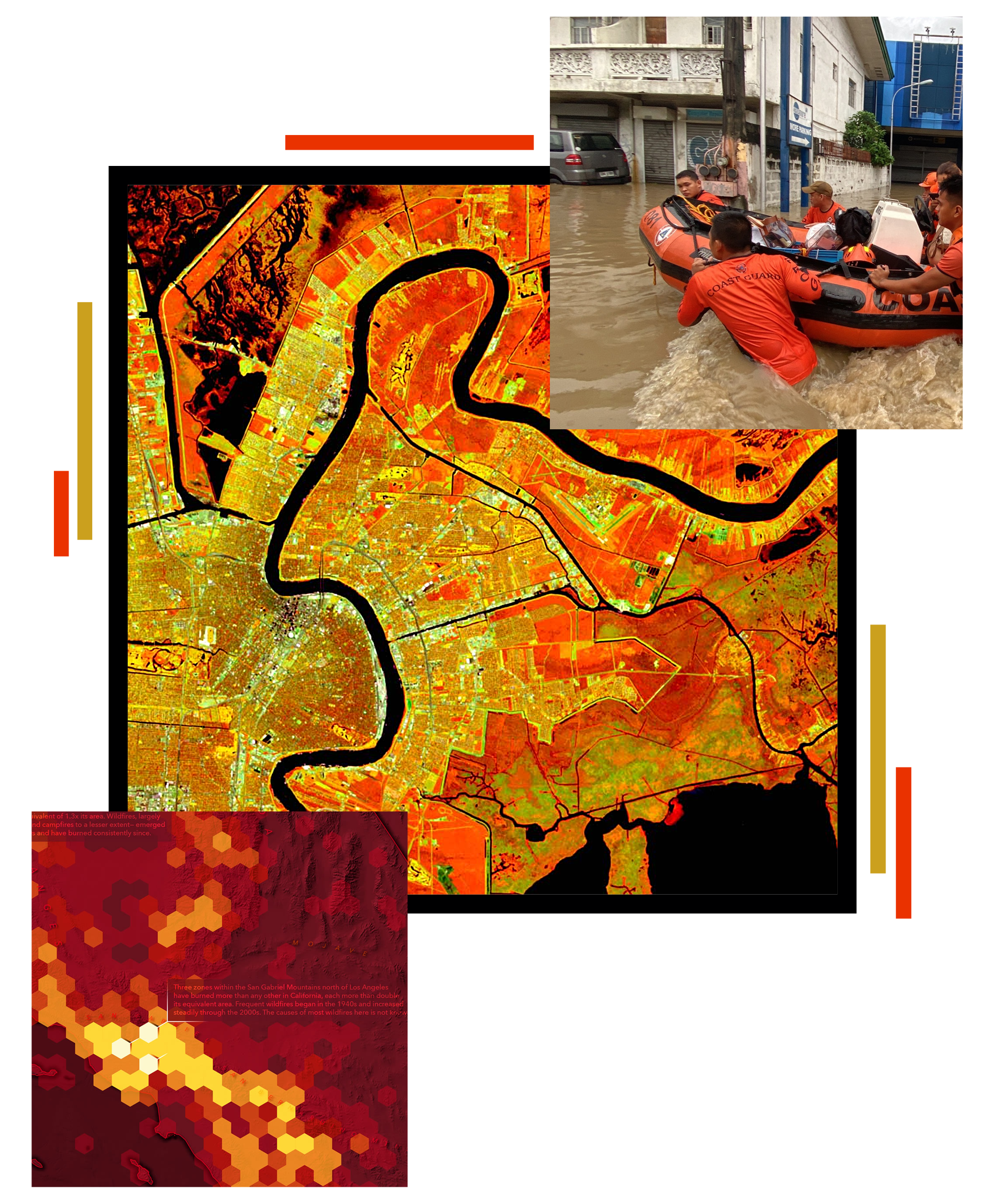
GIS for Climate Change and Disaster Risk Reduction makes it possible to address two of the world’s major global challenges in an integrated manner. It also supports analyses based on objective and up-to-date data. In this way, public decision-makers, technicians, and researchers can better understand environmental dynamics and plan more effective interventions.
First, GIS is used to map and analyze climate data. Consequently, it becomes possible to study rising temperatures, sea-level rise, and the frequency of extreme events. Moreover, spatial analysis allows future scenarios to be projected. Thus, mitigation and adaptation strategies become more robust and verifiable.
Subsequently, data visualization simplifies the interpretation of complex phenomena. Thematic maps and dashboards help identify trends and critical areas. At the same time, continuous monitoring of environmental changes is made possible by Earth observation and change detection capabilities. In this way, information remains constantly updated and useful for timely interventions.
In parallel, within the field of Disaster Risk Reduction, GIS enables systematic risk assessment. As a result, vulnerable areas can be identified, exposed elements can be mapped, and the vulnerabilities of communities and infrastructure can be analyzed. In addition, hazard mapping makes it possible to estimate the potential impacts of disasters.
Finally, GIS supports emergency preparedness planning. For this reason, maps are developed for evacuation routes, resource allocation, and the management of response operations. In summary, GIS for Climate Change and Disaster Risk Reduction strengthens community resilience, reduces risks, and improves the capacity to address future critical events in a structured, coordinated, and sustainable manner over time, contributing to safer territories.